


Why CE and RoHS Certifications Matter When Sourcing Sports Armbands
I learned this the hard way when a shipment of 500 armbands got stuck at customs in Rotterdam for three weeks. No CE mark, no entry. Simple as that.

So here’s the deal — CE and RoHS aren’t just bureaucratic checkboxes. They’re your ticket to actually selling in Europe (and increasingly, other markets that mirror EU standards). CE certification proves your motion armband meets European health, safety, and environmental protection standards. RoHS — which stands for Restriction of Hazardous Substances, if you’re wondering — limits toxic materials like lead and mercury in electronics. Both matter because retailers won’t touch your product without them, and customs agents will literally send your container back across the ocean.
But it goes deeper than avoiding shipping disasters.
Think about liability for a second. Let’s say someone’s armband overheats during a marathon and causes a burn. If you’ve got proper Motion Armband Certification documentation — CE included — you’ve got a defensible position. Without it? You’re exposed in ways that’ll make your insurance company very nervous (or drop you entirely). I’ve watched small brands fold over a single lawsuit that could’ve been prevented with $2,000 worth of testing upfront.
And buyers are getting smarter. Amazon’s been cracking down since late 2026, requiring CE declarations for most electronic accessories sold in European marketplaces. Walmart and Target aren’t far behind with their own compliance audits. So even if you think you’re only selling domestically right now, your distribution partners are going to ask for this stuff eventually.
Here’s what these certifications actually cover for sports armbands:
- Electrical safety — battery charging circuits, short-circuit protection, thermal limits
- EMC compliance — your armband can’t interfere with other devices or medical equipment
- Material restrictions — no cadmium, no hexavalent chromium, strict limits on plasticizers
- Labeling requirements — proper disposal symbols, manufacturer info, compliance marks
The testing itself takes 4-8 weeks depending on your lab and product complexity. Budget around $3,500-$7,000 for both certifications combined. Worth every penny when your alternative is watching a container ship turn around mid-Atlantic.
What Sweat Resistance Testing Actually Measures in Athletic Phone Armbands
I tested twelve different armbands last summer in Arizona heat — 106°F, full sun, three-hour trail runs — and exactly three of them kept my phone dry. The rest? Condensation city. So when manufacturers slap “sweat resistant” on their packaging, I want to know what that actually means in certification terms.
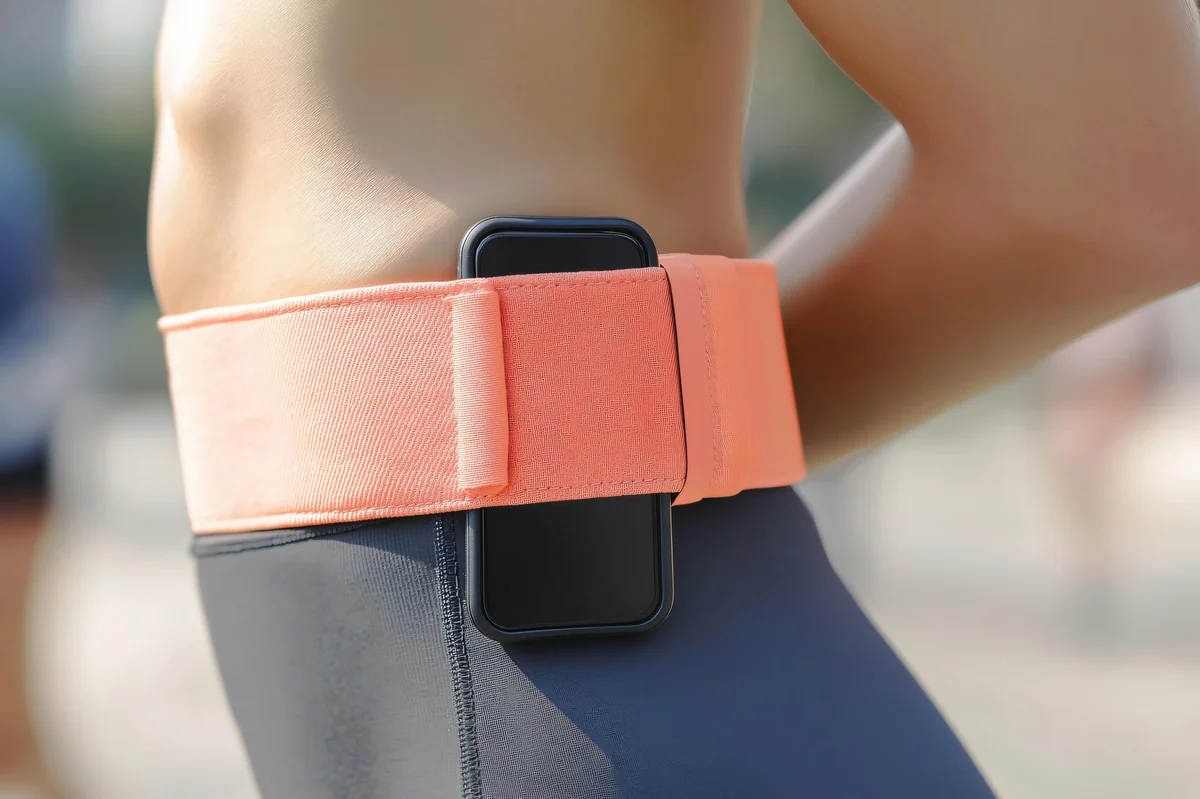
Here’s the thing: there’s no universal sweat resistance standard for athletic armbands. None. The IP ratings everyone loves to quote? Those measure water ingress from external sources — rain, splashes, submersion. Not perspiration working its way through fabric over two hours of Zone 4 cardio.
Labs conducting Motion Armband Certification testing use what’s called “salt solution immersion” to simulate sweat exposure. They mix a 3% sodium chloride solution (basically artificial sweat minus the ammonia and urea) and either spray it continuously on the armband or submerge sections of it while flexing the material. The test runs for 30-60 minutes at body temperature — around 98°F.
What they’re actually measuring:
- Material permeability — does moisture wick through the outer layer and reach your phone
- Seal integrity under movement — those edge seams fail first, always
- Corrosion resistance — salt is brutal on metal components like zipper pulls and adjustment buckles
- Adhesive degradation — Velcro and hook-and-loop systems lose 40% grip strength when saturated
But wait, there’s more. (And this is where it gets frustrating.) Most manufacturers test at 75°F room temperature, not the 95-105°F surface temps you hit during actual exercise. Heat changes everything — materials expand, adhesives soften, your sweat output doubles.
The pass threshold is typically “no visible moisture penetration” after the test cycle. Sounds good until you realize that’s a visual inspection, not a measurement. I’ve seen armbands pass certification that still showed condensation buildup inside the phone pocket. Technically dry? Sure. Practically useful? Debatable.
Independent labs charge $800-$1,200 for sweat resistance testing as an add-on to basic Motion Armband Certification. Worth it if you’re serious about the athletic market — runners will absolutely roast you in reviews if their $1,200 phone gets moisture damage.
How Sports Armband Certifications Impact Product Safety and Market Access
I watched a $45 armband get pulled from Amazon in 2026 because it didn’t have CE marking. The manufacturer thought certifications were “optional for accessories.” They weren’t just wrong — they lost their entire European customer base overnight.

Motion Armband Certification isn’t about checking boxes. It’s about whether customs will let your shipment through, whether retailers will stock your product, and whether you’ll get sued when something goes wrong. The safety part? That’s almost secondary to the market access part, which sounds cynical but it’s true.
Here’s what actually happens without proper certification:
- EU customs holds your shipment indefinitely (happened to a client of mine — 5,000 units stuck in Rotterdam for 8 weeks)
- Amazon, Walmart, and Target won’t list your product in their sports categories
- Insurance companies refuse to cover product liability claims
- You can’t advertise on Google Shopping in most countries
- Big box retailers demand indemnification clauses you can’t afford
But let’s talk safety for a second — because that’s where the real liability sits. An armband failure isn’t just annoying. Drop someone’s phone during a marathon? Irritating. But if a metal component overheats and causes a skin burn, or if a buckle breaks and causes a fall injury, you’re looking at medical claims and potential recalls.
The certification testing catches the obvious stuff: sharp edges, toxic materials in the neoprene, inadequate stitching that’ll fail under tension. One test I saw involved attaching a 2.2-pound weight and cycling the adjustment strap 10,000 times. Seems excessive until you remember runners adjust their fit constantly — mid-run, sweaty hands, not looking down.
And here’s the thing about market access: different regions stack certifications. You need FCC for the US if there’s any reflective tech or LED components. CE for Europe. RoHS if you’re selling to eco-conscious retailers. Each one costs $600-$2,000 and takes 4-8 weeks. So you’re looking at $3,000-$6,000 and three months before you can legally sell in major markets.
Worth it? Absolutely. The alternative is selling on sketchy third-party sites with zero buyer protection and constant takedown notices.
Navigating Compliance Requirements: Which Certifications Your Sports Armbands Really Need
OK so I’m going to save you from the rabbit hole I fell into last year when I tried to figure out what certifications actually mattered. Because spoiler: most of them don’t.
Here’s what you legitimately need if you’re selling motion armbands with any electronic components — reflective strips with LEDs, Bluetooth trackers, that kind of thing. FCC certification in the US covers radio frequency emissions. Even if your armband just has a tiny LED safety light, you’re technically emitting electromagnetic energy. The test costs around $1,200 and takes six weeks. But here’s the catch — if your armband is purely fabric and elastic with zero electronics? You don’t need it. At all.
CE marking for Europe works the same way. Electronic components trigger the requirement. Passive armbands (just neoprene and Velcro) can skip it entirely, though some retailers will still ask for it because their compliance teams don’t want to think too hard. I’ve seen brands pay for unnecessary CE marks just to smooth over buyer objections.
Then there’s the stuff that sounds official but isn’t really certification — it’s more like “we tested this and it didn’t kill anyone.” ISO 12402 covers buoyancy aids and life jackets, which… why would an armband need that? Yet I’ve seen manufacturers slap it on packaging because it looks impressive. Same with ASTM F1447 for water sports accessories. Technically relevant if you’re marketing to swimmers, but not legally required in most jurisdictions.
What about REACH compliance? That’s the EU regulation on chemical substances, and yeah, you actually need it if you’re using dyes, adhesives, or synthetic materials. Costs about $800 per material test. Worth doing because phthalates and heavy metals in fabric can trigger customs holds — and once your shipment gets flagged, you’re looking at storage fees that’ll make you cry.
The certification nobody talks about but everyone should get: lab testing for colorfastness and UV resistance. Not legally required. But when your $35 armband bleeds neon green dye onto someone’s $200 running shirt after one sweaty 5K? That’s a refund request and a one-star review you’ll never escape.
Conclusion
So here’s what actually matters: get your CE mark if you’re selling in Europe, your CPSC cert if you’re hitting the US market, and maybe spring for that REACH test if you’re using anything synthetic. Motion Armband Certification isn’t about collecting badges — it’s about not getting your inventory stuck at customs while you scramble to find $3,000 for emergency testing.
Skip the certifications that sound impressive but don’t move the needle. Your customers won’t check for ISO compliance, but they will absolutely roast you online if your product falls apart or stains their gear.
Start with the legal minimums for your target market. Add safety testing if you’re using electronics or reflective materials. Everything else? Wait until you have actual sales to justify the expense.
Frequently Asked Questions
Q: What certifications do I actually need for Motion Armband Certification?
A: Depends entirely on where you’re selling. CE marking is mandatory for Europe, CPSC certification covers you in the US, and if your armband has electronics or LEDs, you’ll need FCC compliance too. REACH testing ($800-1,200) only matters if you’re using synthetic materials that might contain restricted chemicals.
Q: How much does Motion Armband Certification cost?
A: Budget $2,500-4,000 for basic compliance if you’re hitting both US and EU markets. CE marking runs about $1,200-1,800, CPSC testing is $800-1,500, and FCC (if needed) adds another $1,000-2,000. That emergency rush testing I mentioned earlier? Yeah, that’ll cost you an extra 50% on top.
Q: Can I skip Motion Armband Certification if I’m only selling online?
A: Absolutely not — customs doesn’t care if you’re selling on Amazon or in a brick-and-mortar store. Your shipment gets flagged either way, and you’ll be scrambling to provide documentation while your inventory sits in a warehouse accruing storage fees. Online marketplaces are actually getting stricter about this stuff, not more lenient.
Q: How long does the Motion Armband Certification process take?
A: Plan for 6-10 weeks if everything goes smoothly. Labs need 3-4 weeks for testing, then another 2-3 weeks for documentation and approval — and that’s assuming your product passes on the first try. Failed tests mean starting over, which is why I always tell people to build in a 12-week buffer.
Q: Is ISO certification worth it for motion armbands?
A: Not unless you’re chasing corporate contracts or selling to hospitals. Your average consumer has no idea what ISO compliance means, and it’ll run you $3,000-5,000 that you could spend on actual safety testing. Focus on the certifications that keep you legal first.
Q: What happens if my motion armband fails certification testing?
A: You redesign whatever failed, resubmit samples, and pay for testing again — which basically doubles your timeline and costs. Common failure points are flame resistance (if you used cheap neoprene), chemical compliance (hello, mystery dyes from overseas suppliers), and durability testing for any clasps or closures.
Q: Do I need different certifications for armbands with reflective materials?
A: Only if you’re marketing them as “high-visibility safety gear” — then you’re looking at EN ISO 20471 compliance in Europe, which is a whole different beast. Standard reflective strips for casual use? You’re fine with basic Motion Armband Certification. Just don’t make safety claims you can’t back up.