

How to Match Car Phone Holder Types to Different Vehicle Models and Configurations
Vehicle configuration varies far more than most procurement teams initially account for. Dashboard curvature, windshield rake angle, vent louver width, console depth — these aren’t trivial differences. They determine whether a vehicle-specific mount performs reliably across an entire fleet or becomes a constant source of driver complaints and replacement orders.
The matching process starts with vehicle class segmentation. Compact sedans and hatchbacks typically have shallower dashboards and steeper windshields, which affects adhesive pad geometry and suction cup arm length. Full-size SUVs and pickup trucks present the opposite problem — wide center consoles, elevated seating positions, and vent placements that often conflict with standard clip designs. A car holder for specific car models in commercial fleets needs to account for these dimensional constraints before any other buying criterion enters the conversation.
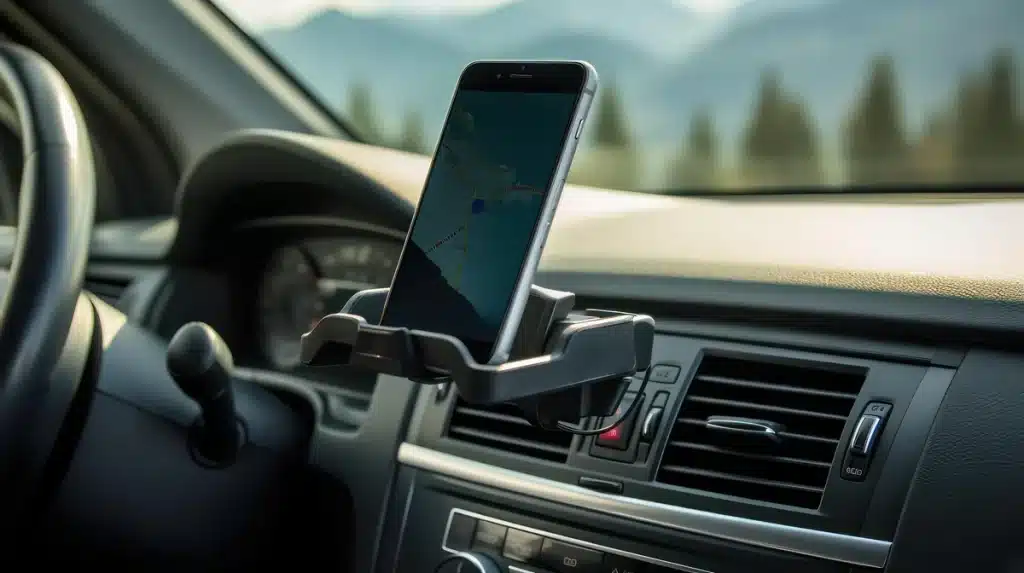
Vent-mount designs are particularly model-sensitive. Horizontal blade vents — common in European sedans — accept clip geometry differently than the vertical or angled louvers found in many Asian-market vehicles. Procurement managers sourcing across mixed fleets should request model compatibility matrices from suppliers rather than relying on generic “universal fit” claims. Suppliers with genuine OEM/ODM capability, like Shuowei, can provide customized bracket configurations mapped to specific vehicle lines — which matters when you’re placing volume orders across multiple model years.
Here’s a practical framework for matching mount type to vehicle configuration:
- Vent clip mounts — best suited for vehicles with firm, evenly spaced horizontal louvers; avoid for vehicles with fragile or angled vents
- Dashboard adhesive mounts — appropriate for flat or low-curve dash surfaces; incompatible with textured or soft-touch materials without specialized adhesive pads
- Windshield suction mounts — reliable on high-rake windshields common in sedans; may violate local regulations in certain markets, worth verifying before fleet-wide deployment
- CD slot and console mounts — viable for older fleet vehicles with legacy hardware; increasingly irrelevant in newer model years
One underappreciated variable is cabin vibration profile. Heavy-duty vehicles — delivery vans, utility trucks — transmit significantly more road vibration than passenger cars. A vehicle-specific mount specified for passenger sedan use will degrade faster in commercial van applications, even if the physical fit appears correct. Sourcing teams should flag vehicle duty cycle alongside model type when briefing suppliers on product requirements.
Sourcing Car Phone Holders for Specific Car Compatibility: What Procurement Teams Must Verify Before Ordering
Procurement teams sourcing a vehicle-specific mount at volume face a verification problem that goes beyond basic dimensions. Fit data published in supplier catalogues is often generated from static measurements — it doesn’t account for trim variations within the same model year, regional market differences in interior specification, or the tolerance stack-up that occurs when multiple components interact. Before committing to an order, buyers need to close that gap systematically.

The first checkpoint is model-year granularity. Requesting compatibility data at the “make and model” level is insufficient. Dashboard geometry, vent orientation, and console depth can shift between production runs of the same nameplate — sometimes mid-year. Procurement teams should require suppliers to specify compatibility down to model year and trim grade, and cross-reference that against the actual fleet or retail SKU range being served.
Beyond fit data, there are several supplier-side verifications worth building into the qualification process:
- Physical sample testing against target vehicle interiors — not just CAD data review — before approving tooling or production runs
- Confirmation that the mount design accommodates phone case thickness variance, since end users rarely mount bare devices
- Material certifications relevant to dashboard contact surfaces — certain plastics and adhesives can cause finish damage that generates warranty claims
- Documentation of vibration and thermal cycle testing, particularly if the car holder for specific car applications will be deployed in commercial or fleet contexts
- Clarity on MOQ thresholds for custom fitment configurations, since vehicle-specific SKUs inherently fragment demand across multiple variants
Lead time is another variable that compounds quickly with vehicle-specific sourcing. Each additional fitment variant adds tooling complexity. Suppliers with OEM-adjacent manufacturing experience — the kind that handles customized specifications and coordinates across multiple SKU configurations — tend to manage that complexity more reliably than general accessory manufacturers. It’s worth asking directly how a supplier handles mid-run fitment revisions, because fleet vehicle specs sometimes change after an order is placed.
Finally, market compliance deserves its own line on the verification checklist. Windshield-mount restrictions were flagged earlier, but dashboard-contact adhesives and vent-clip load tolerances also fall under product liability considerations in several export markets. Confirm that the supplier’s quality documentation covers the specific destination markets in the order, not just a generic CE or RoHS declaration.
MOQ, Lead Times, and OEM Flexibility When Buying Car Phone Holders Across Mixed Vehicle Fitments
Procurement gets complicated fast when a single order spans multiple vehicle fitments — and that complexity shows up earliest in MOQ conversations. A supplier quoting a blanket MOQ across all SKUs sounds efficient until the buyer realizes that a vehicle-specific mount for a mid-size SUV platform and one engineered for a compact EV chassis are effectively different products, each with their own tooling assumptions and component tolerances. Suppliers with genuine OEM/ODM depth will typically negotiate MOQ at the configuration level, not just the order level — which matters considerably when a fleet buyer needs unequal quantities across fitments.

Lead times deserve the same scrutiny. Standard accessory timelines rarely account for the fitment verification cycle that responsible vehicle-specific mount production actually requires — sample fitment testing, revision loops, and market-specific documentation checks all add time that generic lead time quotes ignore. Ask for a breakdown: tooling lead time, pre-production sample timeline, and bulk production window as separate figures. A supplier that quotes a single flat number for all three stages is either very experienced or not being precise enough.
OEM flexibility is where the practical gaps between suppliers become visible. The ability to source a car holder for specific car configurations — rather than forcing buyers into a standard catalog bracket with marginal fitment — depends on whether the supplier’s engineering team is set up for multi-SKU coordination or optimized for high-volume single-SKU runs. These are different operational models. Buyers sourcing across mixed vehicle platforms benefit from working with suppliers who have project coordination infrastructure rather than just production capacity.
- Confirm MOQ is quoted per configuration, not per consolidated order
- Request itemized lead time breakdowns across tooling, sampling, and production phases
- Verify whether fitment revision requests mid-run trigger additional tooling charges or delay penalties
- Clarify whether custom branding or labeling adds to lead time independently of the production schedule
Suppliers with export-oriented fulfillment experience — the kind that regularly handles mixed-fitment orders destined for different regional markets — tend to build these variables into their quoting process from the start, which reduces the back-and-forth that erodes procurement timelines.
Quality Benchmarks and Certification Criteria for Commercial-Grade Car Phone Holder Procurement
Certification requirements for a vehicle-specific mount procurement program are not uniform across markets — and that gap creates real exposure for buyers who treat compliance as an afterthought. The baseline expectation in most export markets is RoHS conformity for materials and CE or FCC marking for any unit that incorporates electronic components such as wireless charging coils or powered adjustment mechanisms. But baseline is exactly that: baseline. Fleet operators, automotive OEM partners, and commercial resellers sourcing at volume typically impose additional criteria tied to their own liability frameworks or regional import regulations.
Material quality is where a lot of procurement decisions quietly go wrong. A car holder for specific car applications — particularly those integrated into dashboards or A-pillars — faces thermal cycling stress, UV exposure, and mechanical vibration that generic mount designs simply aren’t engineered to handle. Buyers should request material data sheets, not just product descriptions, and verify that ABS or polycarbonate grades used in structural components meet automotive-adjacent durability standards rather than general consumer-grade specifications.
- Request third-party tensile and fatigue test reports, not just in-house QC documentation
- Confirm grip force ratings are tested at temperature extremes relevant to target markets (desert heat, cold-climate winters)
- Verify that adhesive or suction components — where applicable — are tested for long-term surface compatibility with OEM interior materials
- Check whether the supplier maintains ISO 9001 certification at the factory level, not just at the trading company level
Drop-test and vibration-resistance documentation matters more than most buyers realize until a return cycle surfaces. For commercial-volume orders of a vehicle-specific mount, requesting pre-production samples tested against defined failure criteria — not just visual inspection — is a defensible procurement standard, not an excessive one.
Suppliers with structured QC processes and export-oriented fulfillment experience tend to have this documentation already organized for international buyers, which accelerates the qualification phase considerably. That infrastructure distinction — between a supplier who produces documentation reactively and one who maintains it as a standing export requirement — often surfaces during initial sourcing conversations and is worth probing directly before committing to tooling investment.
Conclusion
Getting a vehicle-specific mount right comes down to two things: fit precision and supplier accountability — and neither one covers for a weakness in the other.
Tooling investment without verified QC documentation is just an expensive gamble. Probe the supplier early, ask for actual test records, and treat pre-production samples as non-negotiable rather than a courtesy request. Suppliers who handle export volume regularly won’t flinch at that ask — the ones who do are telling you something.
Do that work upfront, and the back-end headaches mostly disappear.
Frequently Asked Questions
Q: What is a vehicle-specific mount, and how is it different from a universal mount?
A: A vehicle-specific mount is engineered to fit one defined make, model, and sometimes trim level — using the factory bolt pattern, dash contours, or headrest geometry of that exact vehicle rather than a generic bracket that approximates fit across dozens of different interiors. Universal mounts rely on adjustable clamps and adhesive pads to compensate for what they don’t know about your car; vehicle-specific mounts don’t need to compensate because the geometry is already solved at the design stage. That difference shows up immediately in stability, rattle resistance, and overall install quality.
Q: How much does tooling for a vehicle-specific mount typically cost?
A: Tooling costs vary widely depending on complexity, material, and the supplier’s location — but for injection-molded plastic components, expect anywhere from a few hundred to several thousand dollars per mold cavity, with more complex multi-part assemblies running higher. That upfront cost is why pre-production sampling and QC documentation matter so much; committing to tooling without validating fit against actual vehicle measurements is where most sourcing mistakes get expensive.
Q: Why does a vehicle-specific mount cost more than a universal option?
A: The price difference reflects real engineering work — CAD modeling against OEM interior data, dedicated tooling that serves a narrower SKU, and tighter dimensional tolerances that require more controlled production. A universal mount is a volume play; a vehicle-specific mount is a precision play. Buyers who skip the price difference often end up absorbing return rates or warranty claims that quietly erase the savings.
Q: Can I use a vehicle-specific mount on a different car model than it was designed for?
A: Technically possible in some cases — particularly if two models share a platform or similar dash architecture — but not advisable without verifying the actual mounting geometry. A vehicle-specific mount that’s forced onto an unintended application loses its core advantage: guaranteed fit. Misalignment stress on mounting points can also damage interior trim over time.
Q: How long does it take to develop a vehicle-specific mount from scratch?
A: From initial design brief to pre-production sample, the timeline typically runs eight to sixteen weeks — longer if tooling revisions are needed after the first sample review. Suppliers with active OEM fitment experience tend to compress that window because they’re not building CAD methodology from scratch. Rushing this stage to hit a launch date is one of the more reliable ways to inherit fit problems at scale.
Q: What should I ask a supplier before ordering a vehicle-specific mount in bulk?
A: Ask for test records from previous fitment runs — not just a spec sheet — and request a pre-production sample against your target vehicle before releasing the full order. Probe whether the supplier actively maintains vehicle-specific tooling or treats it as a one-off favor; the answer tells you a lot about how seriously they take dimensional accountability. Suppliers handling regular export volume on vehicle-specific mounts won’t hesitate at either request.
Q: Is a vehicle-specific mount worth it for aftermarket accessories like phone holders or dashcams?
A: For consumer-facing products where the end user expects a clean, rattle-free install — absolutely. A vehicle-specific mount turns an accessory that looks aftermarket into one that looks like it shipped with the car, which directly affects perceived product quality and review scores. The tooling investment is harder to justify for low-volume or highly fragmented vehicle lineups, but for popular platforms with strong sales concentration, the ROI is usually straightforward.
Q: How do I verify that a vehicle-specific mount will actually fit before committing to a full production run?
A: Require a physical pre-production sample and test it in the actual target vehicle — not a similar model, not a showroom photo comparison. Dimensional drawings are useful for alignment checks, but real-world install testing catches the things CAD doesn’t: panel flex, trim interference, and clip engagement under vibration. Treat that sample review as a gate, not a formality.