


What “Eco-Friendly” Actually Means in Tablet Case Manufacturing (And Why Buyers Should Care)
The phrase “eco-friendly” gets applied to a lot of products that don’t quite earn it — and tablet cases are no exception. For procurement managers evaluating suppliers, that ambiguity isn’t just a marketing problem. It creates real compliance risk, especially when sourcing for markets with tightening environmental regulations or for clients who require documented sustainability credentials along the supply chain.

So what does the term actually mean in a manufacturing context? Broadly, it covers three overlapping areas: the materials used in production, the processes by which those materials are converted into finished goods, and the end-of-life behavior of the product itself. A case made from recycled PET fabric but assembled using solvent-based adhesives with no VOC controls isn’t genuinely sustainable — it’s just partially sustainable, which is a meaningful distinction when you’re putting your procurement decisions on paper.
Material selection is usually where the conversation starts. Common inputs in a legitimate eco-friendly tablet case include:
- Recycled or post-consumer PET (rPET) — typically sourced from reclaimed plastic bottles
- Natural or organic cork — biodegradable and harvested without killing the source tree
- Flax or hemp-based composites — lower water and pesticide footprint than conventional textiles
- Bio-based or recycled TPU — a more nuanced category, since “bio-based” doesn’t automatically mean biodegradable
- FSC-certified or rapidly renewable bamboo — relevant for rigid or semi-rigid case structures
But material origin is only part of the picture. Manufacturing process controls — energy sourcing, wastewater treatment, chemical management — determine whether a supplier’s environmental claims hold up under scrutiny. This is where third-party certifications become operationally useful rather than just cosmetic. Certifications like OEKO-TEX STANDARD 100, GRS (Global Recycled Standard), and ISO 14001 give buyers an auditable reference point rather than a supplier’s self-reported claim.
For B2B buyers, the commercial case for specifying a sustainable tablet case goes beyond optics. Increasingly, retail partners and institutional clients are pushing environmental criteria upstream — requiring documentation, restricting certain materials, or applying scoring systems that affect vendor selection. Getting ahead of those requirements at the sourcing stage, rather than scrambling to retrofit compliance later, is where procurement strategy actually earns its value.
Vetting Sustainable Tablet Case Suppliers: Certifications, Materials, and Red Flags to Watch
Supplier claims around sustainability are easy to make and difficult to verify — which is exactly why documentation trails matter more than pitch decks. When sourcing a sustainable tablet case at volume, the vetting process needs to start with certifications that carry third-party audit requirements, not just self-declared compliance.

The certifications worth requiring — not just requesting — tend to cluster around three areas: material origin, chemical safety, and environmental management systems. A supplier holding GRS certification for recycled content has had that claim independently verified against a chain-of-custody standard. OEKO-TEX STANDARD 100 addresses chemical safety at the material level. ISO 14001 speaks to how a factory manages its broader environmental footprint. None of these overlap completely, so a credible eco-friendly tablet case supplier will typically hold more than one.
Beyond paper credentials, the materials conversation gets more specific. Recycled PET, cork, organic cotton, and plant-based PU are all legitimate options — but each carries different lead time implications, MOQ thresholds, and tooling considerations depending on the supplier’s actual production capabilities. Asking for material data sheets and traceability documentation early in the conversation separates suppliers with real infrastructure from those reselling someone else’s product under a sustainability label.
Red flags worth flagging to procurement leadership:
- Certifications that expired more than 12 months ago and haven’t been renewed
- Vague language like “eco-friendly materials” with no specification of what those materials actually are
- No documented quality control process at the material intake stage
- MOQ structures that don’t accommodate pilot orders — a supplier unwilling to run a smaller certified batch is often one without flexible production capability
- Inability to provide a product-specific Bill of Materials that names material suppliers
Suppliers with genuine OEM and ODM depth — the kind that handle customized specifications and export-oriented fulfillment — will typically have this documentation ready without significant prompting. That responsiveness itself is a signal. When a supplier can produce audit-ready materials quickly, it usually means compliance is embedded in their process rather than assembled on request.
The sourcing decision for an eco-friendly tablet case at the B2B level isn’t just about finding the greenest product on offer. It’s about finding a supplier whose documentation holds up when your own clients or retail partners start asking questions — and they will.
How to Evaluate Sustainable Tablet Case Options Against Real Procurement Criteria
Procurement decisions for an eco-friendly tablet case rarely fail because buyers chose the wrong material. They fail because the evaluation criteria didn’t match what actually mattered operationally. Green credentials get the product on the shortlist. But lead times, MOQ flexibility, and documentation depth are what determine whether a supplier relationship holds up across multiple order cycles.
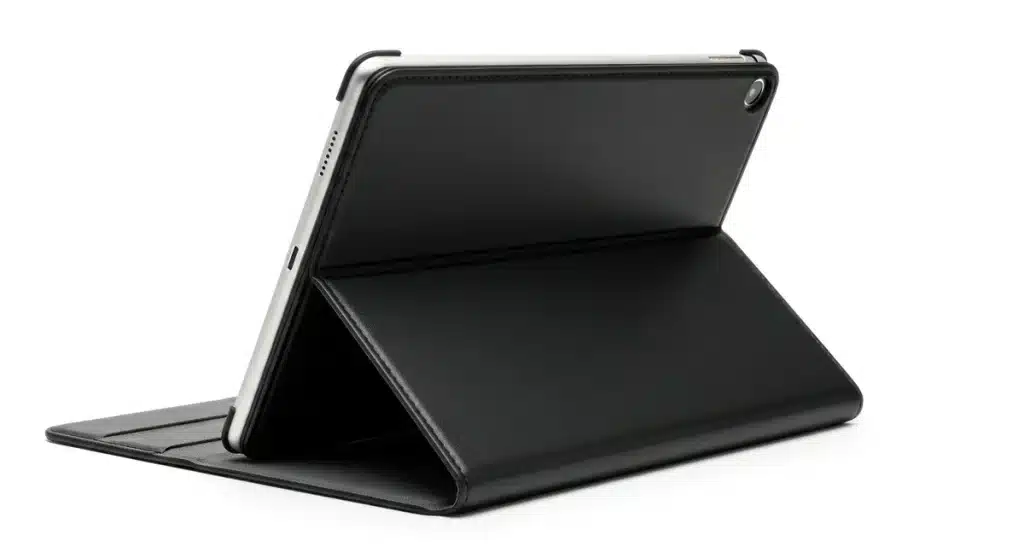
Start with the practical constraints before the sustainability checklist. What’s the minimum order quantity your volume actually supports? Some certified sustainable materials — recycled TPU, plant-based composites — carry higher per-unit costs that only compress meaningfully at scale. A supplier quoting a sustainable tablet case at competitive pricing on a 500-unit MOQ deserves more scrutiny than one quoting it at 5,000 units. That gap usually signals either a subsidy on their end, or a compromise somewhere in the material chain.
Once volume thresholds are confirmed, evaluate against these procurement-specific criteria:
- Certification scope — does it cover the finished product or only a single input material?
- Lead time stability — are sustainable material lead times longer, and by how much under peak demand?
- Customization depth — can the supplier accommodate logo placement, SKU-level color variation, and packaging specs without abandoning certified materials?
- Reorder consistency — can they guarantee the same material source across multiple production runs?
- Export compliance — do they have documented experience with the import requirements of your target market?
That last point matters more than buyers often anticipate. Regulatory environments in the EU, North America, and parts of Southeast Asia are tightening around material disclosures — and a supplier who sources and fulfills for international buyers regularly will already have frameworks in place. Suppliers with genuine OEM and ODM capability, like those operating in China’s export-oriented manufacturing sector, tend to have this infrastructure embedded rather than built reactively per order.
The evaluation process for an eco-friendly tablet case at B2B scale is ultimately a stress test — not of the product’s sustainability story, but of the supplier’s ability to maintain that story reliably, at volume, and under the documentation demands your downstream partners will eventually impose.
Balancing Cost, MOQ, and Lead Times When Sourcing Eco-Friendly Tablet Cases at Scale
Procurement decisions for an eco-friendly tablet case rarely fail on material selection — they fail on the commercial structure around it. MOQ thresholds, unit economics at different volume tiers, and lead time variability under seasonal demand all interact in ways that catch buyers off guard, particularly when sustainable materials are involved.
Eco-certified inputs — recycled PET fabric, plant-based TPU, FSC-certified board — typically carry longer replenishment cycles than conventional materials. That reality flows directly into your supplier’s production calendar. A factory running on standard petroleum-based materials might quote four to five weeks. The same factory switching to a certified recycled shell or natural fiber lining may need an additional two to three weeks for material procurement alone, depending on batch availability. Buyers who treat sustainable sourcing as a drop-in swap for conventional sourcing will routinely miss their launch windows.
MOQ dynamics shift too. Sustainable material suppliers often impose their own minimum batch requirements upstream, which pushes the finished goods MOQ higher than buyers expect — sometimes significantly. The practical implication: a sustainable tablet case program that looks viable at 5,000 units on paper may require 8,000 units to clear the material supplier’s threshold and still maintain a defensible cost per unit. Export-oriented manufacturers who work regularly with international buyers — particularly those with established OEM and ODM infrastructure — tend to absorb some of this complexity through pre-negotiated material contracts, which is a real operational advantage worth asking about during supplier qualification.
- Request a detailed BOM (bill of materials) with lead times broken out by component, not just finished goods lead time.
- Clarify whether the supplier holds buffer stock of certified materials or sources reactively per order.
- Ask how MOQ is calculated — at the SKU level, the material batch level, or the container level — since these produce very different floor quantities.
- Build at least two additional weeks into your timeline for any first production run using a new certified material.
Cost comparisons between suppliers also need a consistent baseline. An eco-friendly tablet case quoted at a lower unit price may be using spot-purchased recycled content without verified certification — which creates downstream compliance exposure that carries its own cost. Price per unit is only meaningful when the certification standard, material traceability, and delivery reliability are held constant across the comparison.
Conclusion
Certification without traceability is just a sticker. That’s the single thing worth remembering when you’re evaluating any eco-friendly tablet case at scale — because the gap between “claims to be sustainable” and “can prove it through the supply chain” is exactly where compliance problems and reputational risk live.
Get the BOM. Verify the certification standard. And hold your price comparisons to a consistent baseline, or they’re meaningless.
The sourcing side of sustainability isn’t glamorous, but it’s where the real work happens — and buyers who nail the qualification process early rarely have to redo it under pressure later.
Frequently Asked Questions
Q: What materials are used in an eco-friendly tablet case?
A: The most common materials are recycled PET (often sourced from post-consumer plastic bottles), natural cork, organic cotton canvas, and plant-based or water-based PU alternatives — each with very different durability profiles. Cork and recycled PET tend to hold up better over time; organic cotton is softer but more prone to wear at the corners. The catch is that “eco-friendly” on the label doesn’t tell you which material you’re actually getting, which is why requesting a full Bill of Materials from your supplier matters more than the marketing description.
Q: How do I know if an eco-friendly tablet case certification is legitimate?
A: Look for third-party certifications with traceable audit trails — GRS (Global Recycled Standard), OEKO-TEX STANDARD 100, and FSC are the most widely recognized in this category. A legitimate certification includes a transaction certificate or scope certificate you can verify directly on the certifying body’s public database. If a supplier can only offer a self-declared “eco” claim with no third-party documentation, treat that as a red flag.
Q: Is an eco-friendly tablet case actually more durable than a conventional one?
A: It depends entirely on the material — recycled hard-shell polycarbonate cases typically match or exceed the durability of virgin plastic equivalents, while some natural fiber options (like jute or uncoated cotton) are genuinely more vulnerable to moisture and abrasion. The durability gap has narrowed significantly as material science has improved, but buyers should still request drop-test or abrasion-test data rather than assuming “sustainable” means “tough.”
Q: How much does an eco-friendly tablet case cost compared to a standard case?
A: At retail, expect a price premium of roughly 15–40% over a comparable conventional case — though that gap compresses considerably at wholesale or OEM volumes. The premium reflects certification overhead, sometimes higher raw material costs, and the audit infrastructure behind genuine sustainability claims. Buyers comparing unit prices across suppliers should hold certification standard and material spec constant, otherwise the comparison is essentially meaningless.
Q: Can I get a custom eco-friendly tablet case made to my brand’s specifications?
A: OEM and ODM options for eco-friendly tablet cases are widely available — particularly from export-oriented suppliers who already work with certified material vendors. Customization typically covers material choice, colorway (using water-based dyes), logo placement, and packaging. Suppliers like Shuowei that handle customized sourcing for international buyers can often coordinate material traceability documentation alongside the production spec, which saves significant back-and-forth during compliance review.
Q: Why does material traceability matter when sourcing an eco-friendly tablet case?
A: Traceability is what separates a verified sustainability claim from a marketing sticker — without it, there’s no way to confirm that the recycled or natural material in your case actually came from a certified source rather than being blended with unverified inputs. This matters especially for brands operating in markets with tightening import compliance requirements, where the burden of proof sits with the importer. A supplier who can’t provide chain-of-custody documentation for their materials is a liability, not a partner.
Q: How long does an eco-friendly tablet case typically last before it needs replacing?
A: Recycled hard-shell and cork-composite cases generally last two to four years under normal use — comparable to conventional cases. Natural fiber options tend to show wear sooner, particularly around zipper edges and corners, often within 12–18 months of daily use. Longevity is also heavily influenced by construction quality (stitching, hardware), so the material alone isn’t the whole story.
Q: What should I watch out for when buying an eco-friendly tablet case at scale?
A: Three things consistently trip up bulk buyers: vague material descriptions (watch for “eco-leather” with no further spec), certifications that apply to the supplier’s facility rather than the specific product, and price comparisons made across inconsistent baselines. An eco-friendly tablet case that’s cheap because the certification is self-declared isn’t actually comparable to one backed by GRS or OEKO-TEX audit — and that distinction only surfaces when a compliance issue does.